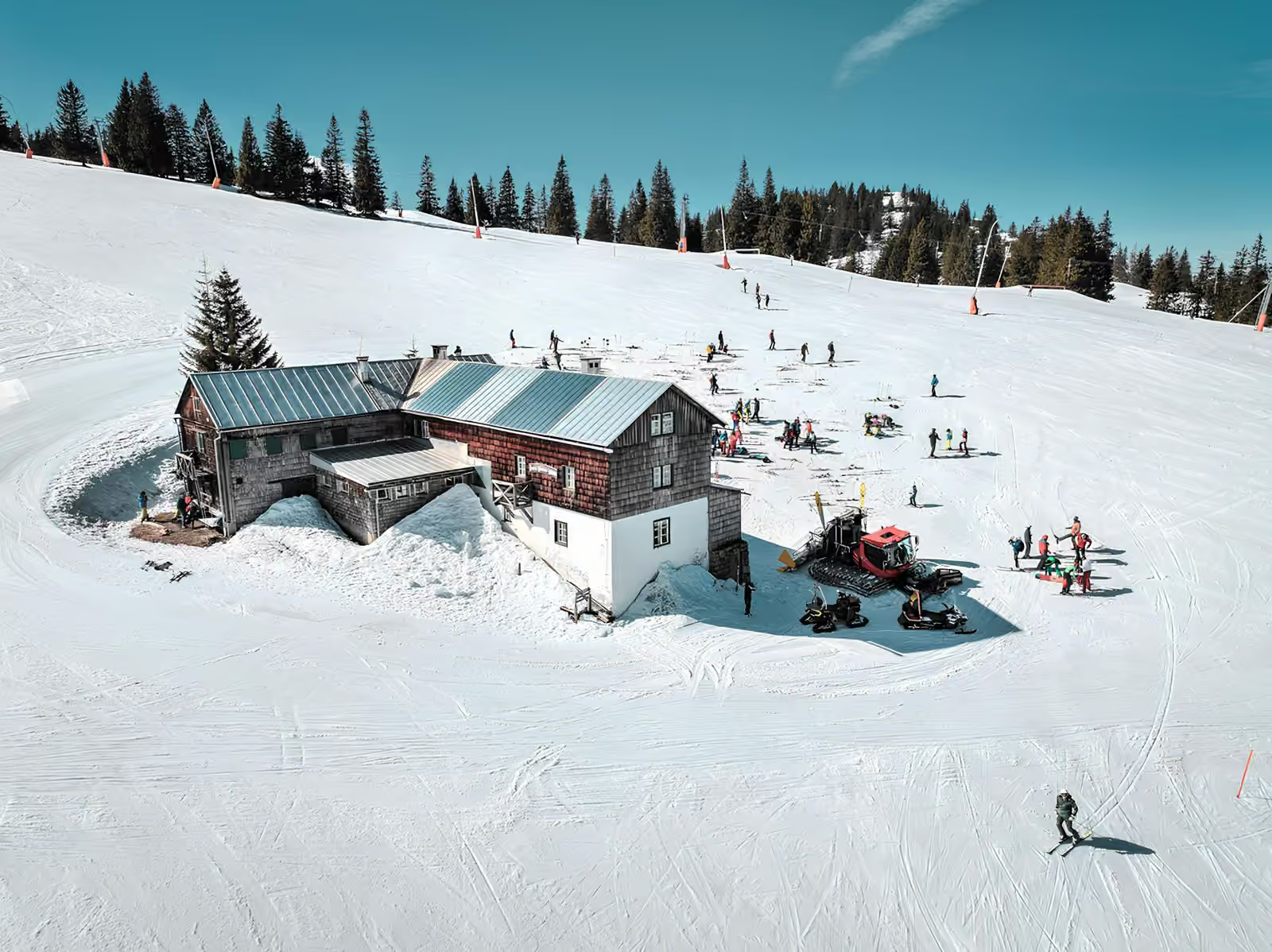
Ski-in / Ski-out in Savoie: What the Phrase Actually Guarantees
No French agency polices this term. It is used for hotels on the piste and for hotels a firm walk from a bubble, and the gap between those two weeks is large. Treat it as a claim to check rather than a specification.
Ask for the walk in metres or minutes and the name of the lift. A property that genuinely sits on the snow will answer immediately; one that does not will answer in adjectives. That single question resolves most of the ambiguity in this category.
Ski-out and ski-in are often different distances. Plenty of hotels let you leave on skis downhill and require a walk or a shuttle to get back at the end of the day, when everybody is tired and carrying more. Ask about the return specifically.
In high purpose-built resorts the premium barely exists, because almost everything is close to a lift. Val Thorens at 2,300 m is the clearest case: the resort was laid out around the ski area rather than growing outward from a village, so paying extra for proximity buys very little when the alternative is a 3-minute walk. Paying for sunlight or quiet buys a great deal more.
Where the premium is real is in resorts that grew from villages. Courchevel, Méribel and Val d'Isère all have a genuine price gradient between the piste and the centre, and that is where the phrase earns its money — and where it is worth verifying hardest.
Worth knowing before you book
- Ski-in and ski-out are frequently not both true
- Plenty of hotels ski out onto a piste and need a lift or a navette to get back. Ask which of the two directions actually works, and on which named run.
- The return run has a grade, and it decides everything
- A hotel reached by a red run is not accessible to half of most groups. The colour of the final 300 metres matters more than the total distance quoted.
- Ask for the lift name, not the walking time
- Walking times are written by marketing departments. A named lift can be found on the piste map and the distance measured yourself.
- Late-season afternoon sun changes the answer
- A return slope that works in January can be bare by 16:00 in April if it faces south. Ask which way the final approach is oriented before booking a spring week.
Who this style is wrong for
If you are a beginner this is usually the wrong thing to pay for. Ski aux pieds means the piste reaches the door, and the piste that reaches the door is rarely a piste verte. A first-week skier who cannot ski the return run gets no benefit and takes the lift down anyway, having paid the premium for it.
It is also worth less at 2000 m than the phrase suggests, because at that altitude most of the resort is already slopeside. When everything is ski aux pieds, the words stop being a differentiator, and the things actually worth paying for are sunlight, quiet and a better room.
What to verify before booking
If a listing will not answer these, assume the answer is unfavourable.
- How many metres to the nearest lift, and which lift is it called?
- Can you ski back to the door, or only ski out from it?
- Is the return route open all season, or does it depend on snow at village level?
- Is there a ski room at ground level, or stairs between it and the snow?
- In a purpose-built resort, what does the premium buy beyond proximity everyone already has?
Search ski-in / ski-out hotels
- Val ThorensCheck availability
- Les MenuiresCheck availability
- TignesCheck availability
- CourchevelCheck availability
Some outbound booking links earn us a commission at no extra cost to you. No hotel pays to appear here.
Where this style works best
More coverage coming this season.
Frequently asked questions
Is ski-in/ski-out worth paying for?
It is worth most to families carrying equipment for children and least to two adults who ski all day and would walk anyway. In a high purpose-built resort it is often not worth anything, because the alternative is a three-minute walk.
Which resort has the most genuine ski-in/ski-out?
Val Thorens, by a distance — it is normal there rather than a premium feature. Les Menuires is close behind and considerably cheaper.